Reading the Terrain ~ A Clinical Immersion Series for the Community Herbalist, Atlanta.
Registration: Individual Class l Bundle
Next class: Sunday, October 4, 10am-5pm
Each class is designed to be entered on its own, and each one deepens the last.
Decatur, Georgia.
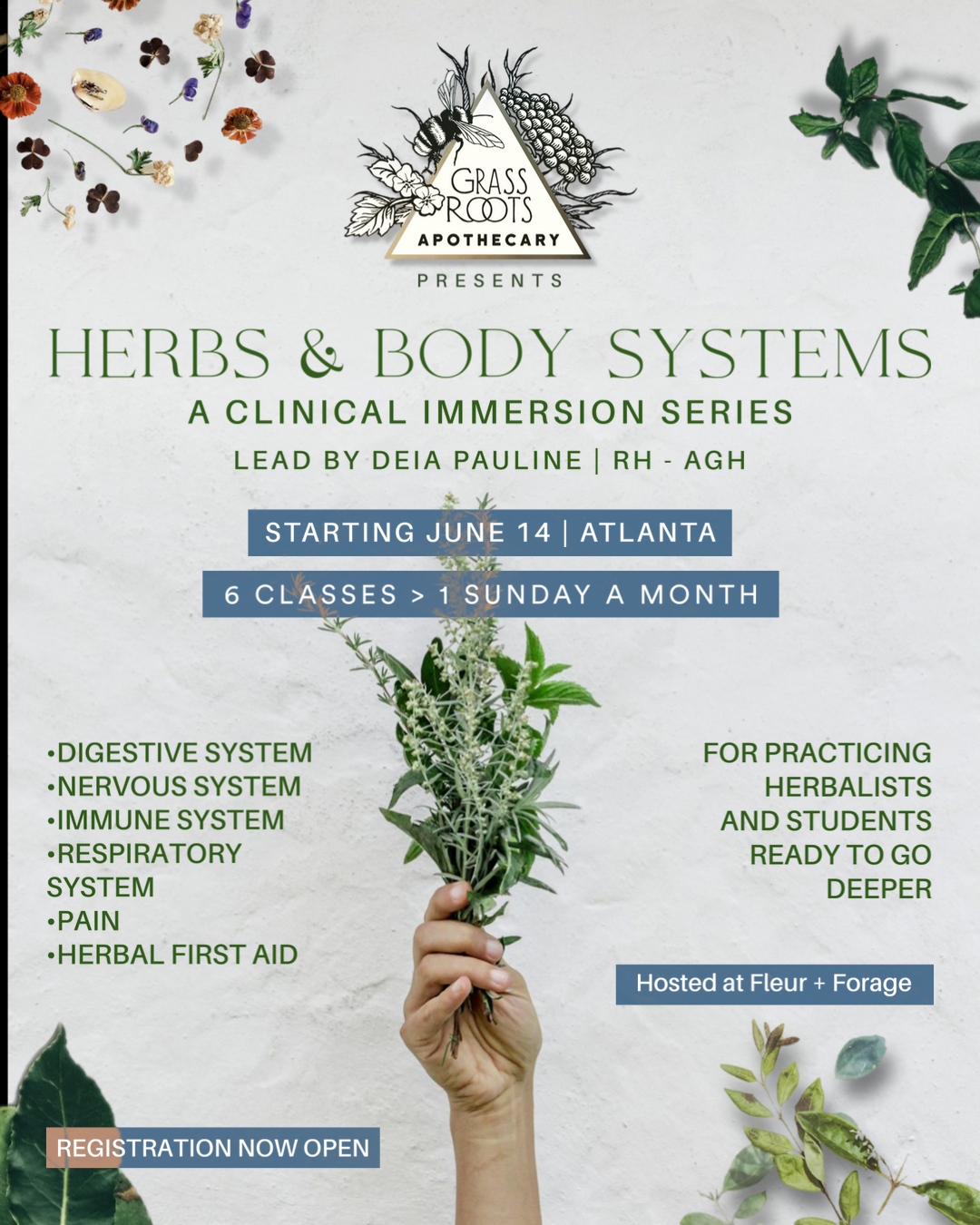
Why these classes?
These classes are about learning to look at a presentation, understand what you're seeing, and choose herbs and preparations with a reason behind your choices.
We are living through a period of compounding instability. Healthcare is increasingly inaccessible and impersonal. Food systems are fragile. Communities are fractured. Ecological, political, and economic pressures are converging in ways people feel every day in their bodies.
This is not a collection of individual problems. These conditions emerge from systems that prioritize extraction over relationship, profit over care, and disconnection over community.
In this landscape, knowing how to work with plants, how to read the body, and how to support the people around you is more than a hobby. It is a practical skill. It is community infrastructure. It is a form of continuity.
Herbal medicine has long been part of how people care for one another when institutions fail to meet their needs. That knowledge remains alive because people continue to practice it, adapt it, and pass it on.
This series is for people who already know some herbs and want a deeper framework for when and how to use them. We build discernment, pattern recognition, and sound clinical reasoning. We learn to assess presentations, recognize meaningful patterns, and match herbs to the person in front of us rather than to a symptom list.
We practice that reasoning out loud in every class, working through what you'd actually ask the person in front of you. The final two classes bring those skills together more explicitly through the art of intake.
Because same diagnosis does not mean same pattern.
The goal is not simply to know more herbs. The goal is to become more useful.
Take one class or take the series
The same clinical framework travels with every class. Terrain, energetics, tissue states, pattern recognition, and formula reasoning are the spine of each day, applied to a different system. Late starters are not behind. Each class is designed to be entered on its own, and each one deepens the last.
This series began with Digestive, Nervous, and Immune. Three classes remain: Respiratory, Pain, and Herbal First Aid. The final two, Pain and Herbal First Aid, each close with the art of intake, bringing the reasoning practiced throughout the series into a single working framework.
Upcoming Classes
October 4 - Herbal First Aid for Events, Disasters, and the Front Lines + The Art of Intake
Whether you are supporting a neighborhood gathering, a regional festival, a mutual aid response, or a community in crisis, the skills are the same. Drawn from a best practices manual for herbal first aid and wellness spaces at events and on the front lines, and from a larger fifty-hour clinical training and years of field practice, informed by Wilderness First Responder training.
Acute presentations in field conditions: wound care, pain, respiratory distress, digestive crisis, trauma response, heat and cold exposure, anxiety and shock. Scope of practice: when to refer, when to hold, when to act. Safety, consent, and trauma-informed care under stress. Setting up a wellness space: layout, flow, intake, documentation, team coordination. Mutual aid framing, because herbal first aid is collective care, not individual survivalism. Working with what you have: improvised preparations, local plants, community resources. We review intake for field conditions.
Who this is for
Come if you are a practicing herbalist ready to sharpen clinical reasoning. Come if you are a student who wants to move past foundational herb knowledge into the art of it. Come if you have ever sat in an intake feeling uncertain and wanted a clearer framework. Come if you want to be genuinely useful at a gathering, an event, or a moment of community crisis.
That shift happens best in community. Each class is a circle where everyone's knowledge is in the room. We learn from one another as much as from the curriculum.
Hosted in Decatur, Georgia.
How each class works
One Sunday a month, 10 AM to 5 PM.
For body systems classes, you arrive having completed a one-page write-up on the day's topic. Anatomy, physiology, whatever has already landed for you. We come in refreshed on the basics and move into clinical work faster.
Breaks as needed. After a 45-minute lunch we go deeper into conditions and pattern work. Every class closes with an intake practice worked through in circle.
The day runs on a clear structure and a real clock, and it stays conversational. Each session makes space for practitioners to bring their own knowledge and experience into the room. You leave with detailed handouts built to be used in practice, written feedback on your submitted work, and a clearer framework for assessing what you're seeing, asking better questions, and choosing herbs and formulas with a reason behind your choices.
Pricing
Individual class: $150. A $30 non-refundable deposit holds your spot, balance of $120 due by the class date.
Bundle: all three remaining classes, Respiratory, Pain, and Herbal First Aid, for $390.
Active Fleur + Forage Free Clinic volunteers receive a discount code. Reach out.
Healing justice pricing. Cost should not be the thing that keeps you out, and I want the work that goes into it to be held. Reach out.
A percentage of proceeds goes back to Fleur + Forage Free Clinic for hosting. Payment supports the continuity of care and the ability to show up consistently for others.
Deposits may be applied to a future class date if you need to reschedule with prior notice.
Registration
To register for an individual class, click here or email me directly: deiapaulineb@gmail.com
About the instructor
Deia Pauline is a clinical herbalist and educator based in Atlanta, practicing since 2008 and registered with the American Herbalists Guild since 2014. Her path to herbal medicine began in 1997 through activist and Indigenous solidarity work: gatherings and actions on Western Shoshone land, frontline care at Atomic Cafes serving miso and coffee to downwinders, and sacred site defense alongside Indigenous communities.
A longtime Wilderness First Responder and former EMT, she brings field medical grounding to her herbal practice. Trained at Berkeley Herbal Center, Blue Otter School of Herbal Medicine, and The Dhyana Center in Ayurvedic foundations, she now teaches in Berkeley Herbal Center's Village Herbalist 2 program and runs Grassroots Apothecary, a community herbal practice rooted in mutual aid and collective care.
Her field clinical work spans more than two decades: street medic work with Bay Area Radical Health Collective, disaster relief in New Orleans after Katrina and in New York City, MASHH Clinic Collective, and her own herbal wellness clinics at Sunset Campout, Oregon Eclipse, Envision, multiple Women's Herbal Symposiums, Buckeye Earth Skills Gatherings, California wildfire relief, and Fleur + Forage Free Clinic's work serving those most underserved in Atlanta.
Past classes have covered psychedelic support and integration with clinical herbalism, longevity and healthspan, depression and anxiety, and running herbal clinics on the front lines.
You may catch her on a dance floor somewhere, preferably outdoors and under the stars.
This practice exists to keep care alive inside a system that actively devalues it.
Questions, reach out directly.
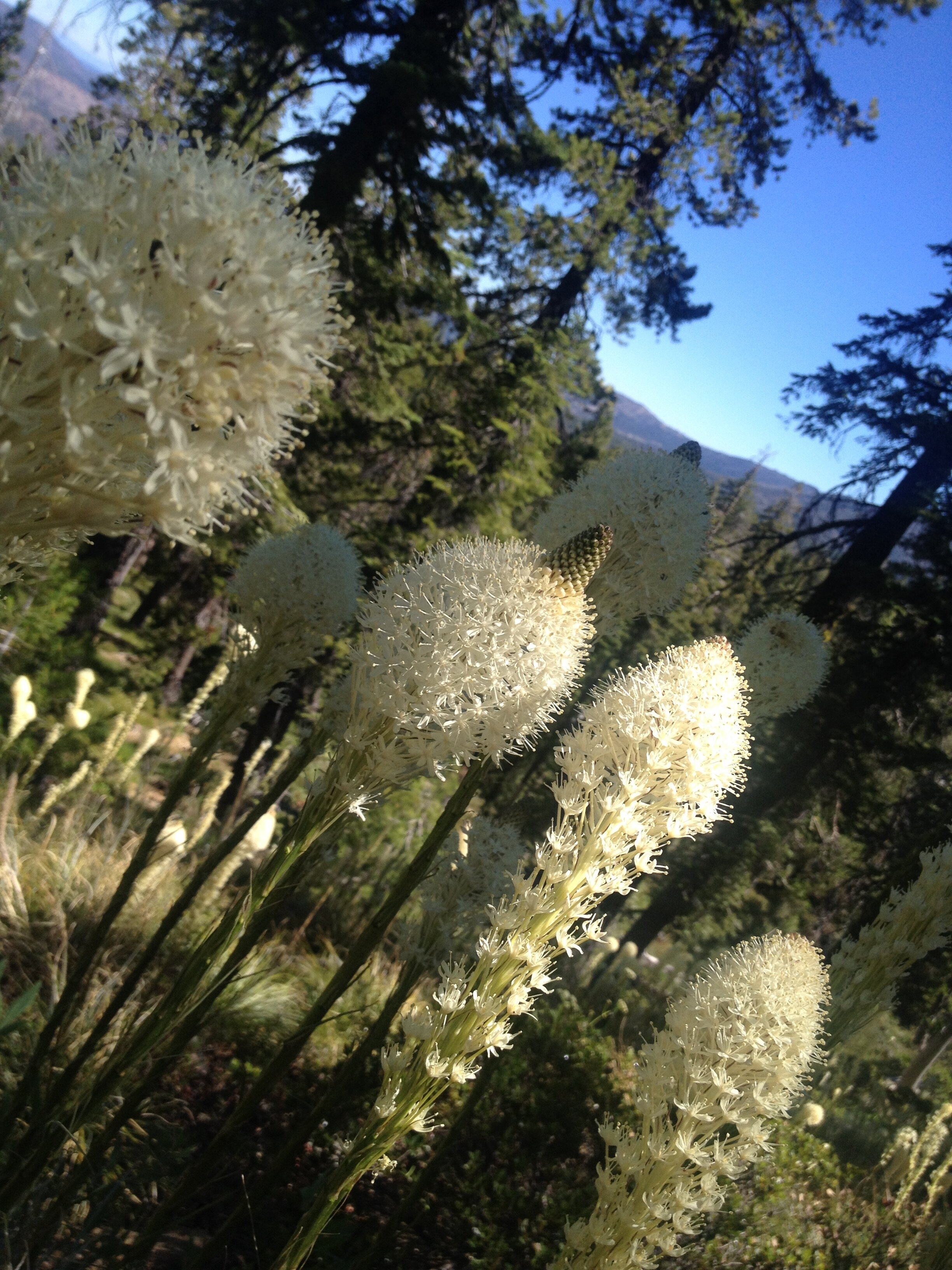
Beargrass in the Marble Mountains